


In 2026, the Fire Risk Assessment types landscape of building safety in the UK has reached a critical turning point. For any property owner, the term Fire Risk Assessment in London is no longer just a line item on a compliance checklist, it is the fundamental legal shield protecting your assets, your tenants, and your professional reputation. With the recent implementation of the Fire Safety (Residential Evacuation Plans) (England) Regulations 2025 on 6 April 2026, and the enforcement of the Renters’ Rights Act 2025 on 1 May 2026, the margin for error in fire safety has effectively vanished .
Understanding which type of assessment your property requires is the first step toward total compliance. At Property Safety LTD, we provide the technical authority and “B2B Performance Assurance” required to navigate these complex shifts. Whether you manage a historic office in Soho or a modern residential block in Canary Wharf, this guide outlines the different types of Fire Risk Assessments (FRA) and helps you choose the right path for your premises.
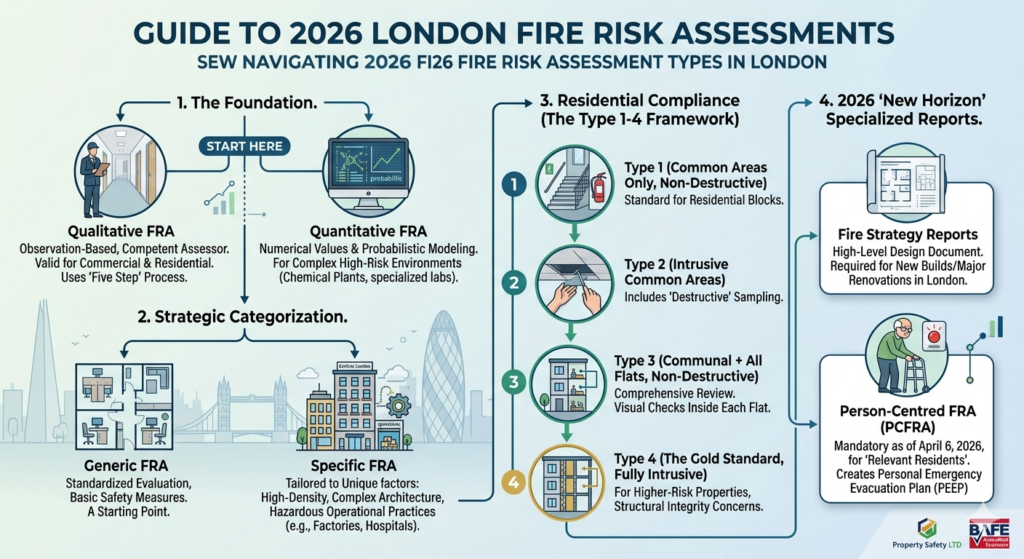
The Foundation for Fire Safety: Qualitative vs. Quantitative Fire Risk Assessment types
Before diving into specific property types, it is essential to understand the two primary methodologies used by professional assessors to evaluate risk.
Qualitative Fire Risk Assessment
This is the most common methodology used for the vast majority of commercial and residential buildings in London. It is an observation-based approach where a competent assessor identifies fire hazards and people at risk, evaluates existing safety measures, and determines if improvements are needed based on professional judgment and established safety principles. It does not involve complex numerical modeling but instead relies on the “Five Step” process recommended by the Health and Safety Executive (HSE).
Quantitative Fire Risk Assessment
A significantly more technical approach, the quantitative assessment uses numerical values and probabilistic modeling to assess the likelihood of a fire and its potential consequences. This type is reserved for complex, high-risk environments such as chemical plants, large-scale industrial sites, or specialized laboratory facilities where a single incident could have catastrophic regional impacts.
Strategic Categorization: Generic vs. Specific Assessments
Choosing between a generic and a specific assessment depends entirely on the complexity of your operations and the physical structure of your building.
Generic FRA
A generic assessment provides a standardized evaluation framework for common types of premises with similar layouts and low-risk profiles. It ensures basic safety measures—such as clear escape routes, functioning smoke alarms, and accessible fire extinguishers—are in place. While cost-effective, a generic assessment is merely a starting point; in the 2026 regulatory environment, London’s unique building stock often requires more depth to satisfy the London Fire Brigade.
Specific FRA
Tailored to a particular building, process, or activity, the specific FRA considers unique factors like high-density occupancy, complex architectural designs, and hazardous operational practices. For factories, hospitals, or multi-story commercial premises in Central London, this type of assessment is mandatory to ensure that niche risks—such as unventilated server rooms or specific industrial machinery—are adequately mitigated.
Residential Compliance: The Type 1–4 Framework
For London landlords and block managers, the “Type” of assessment is dictated by the level of intrusion required to verify fire compartmentation.
- Type 1 (Common Areas Only): This is the standard non-destructive assessment for most residential blocks. It examines the communal hallways, stairwells, and entrance doors to verify they meet the “Stay Put” or “Simultaneous Evacuation” strategy .
- Type 2 (Intrusive Common Areas): Similar to Type 1 but includes “destructive” sampling. The assessor may open up ceiling voids or wall sections in communal areas to check for fire stopping and hidden breaches.
- Type 3 (Communal + All Flats): A non-destructive but more comprehensive review that includes communal areas and a visual check inside every individual flat to verify smoke detection and internal fire doors.
- Type 4 (The Gold Standard): A fully intrusive assessment of both communal areas and individual flats. This is generally reserved for higher-risk properties where significant concerns about the building’s structural fire integrity exist.
Specialized Reports and the 2026 “New Horizon”
Beyond standard assessments, 2026 has introduced new mandatory reporting standards driven by the Building Safety Act 2022 and the Fire Safety Act 2021 .
Fire Strategy Reports
Often required for new builds or major London renovations, a Fire Strategy Report is a high-level design document. It outlines how a building will meet the Building Regulations 2010, detailing escape route capacities, fire protection systems, and structural fire resistance before the building is even occupied .
Person-Centred Fire Risk Assessment (PCFRA)
As of 6 April 2026, the PCFRA is a mandatory requirement for “Relevant Residents” in multi-occupied buildings who may have difficulty evacuating due to physical, sensory, or cognitive impairments . This specialist assessment focuses on the individual’s ability to respond to an alarm and reach a place of safety, leading to the creation of a Personal Emergency Evacuation Plan (PEEP) .
Why Professional Choice is Critical
Choosing the wrong type of fire risk assessment is a costly mistake that can lead to unlimited fines, insurance rejection, and criminal prosecution in cases of negligence . In 2026, the “Responsible Person” cannot delegate their legal liability; you must ensure the assessment is “suitable and sufficient” for your specific premises .
At Property Safety LTD, our BAFE-accredited engineers provide the expertise required to identify exactly which type of assessment your property needs. We specialize in the complex London market, where Victorian conversions and modern high-rises demand different safety strategies.
Which type of fire risk assessment is standard for a London HMO?
Is a Fire Strategy Report different from a Fire Risk Assessment?
What is a “Specific” FRA and when do I need one?
How does the 2026 PEEP regulation affect my FRA?
Can I perform a “Generic” assessment for my London office?
What is the difference between a Type 1 and Type 4 assessment?
Does an FRA need to include external cladding in 2026?
How often should these different types of assessments be reviewed?
What is the penalty for having the “wrong” type of assessment?
Can I bundle different safety certifications to save money?
