

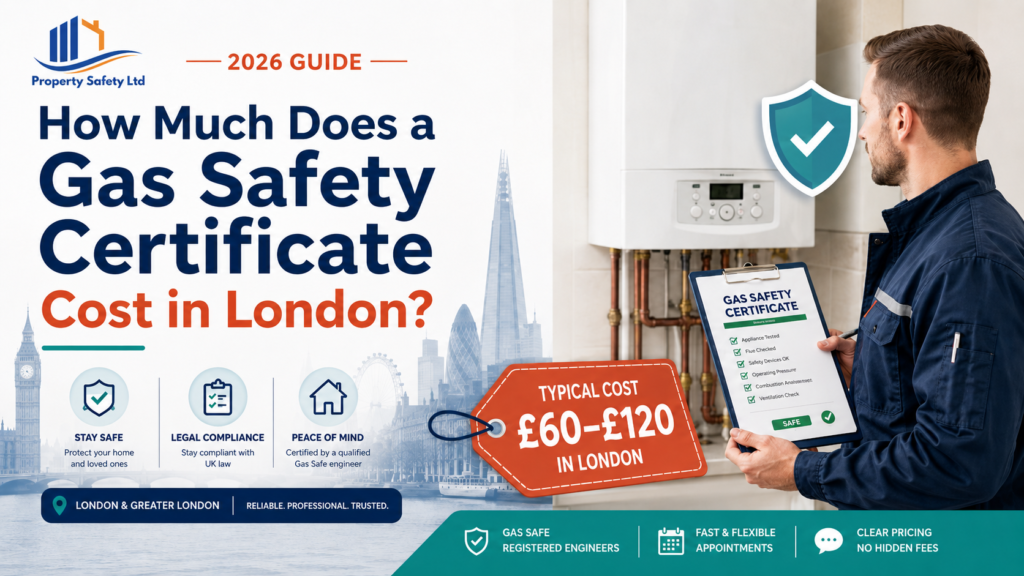
A Gas Safety Certificate is a legal requirement for London landlords and must be renewed at least every 12 months by a Gas Safe registered engineer. There are two main types — the CP12 for domestic properties and the CP42 for commercial premises. Most London landlords pay between £85 and £120 for a standard domestic certificate; Property Safety Ltd’s CP12 starts from £59.99.
If you let a property in London, a gas safety certificate is one of the few documents you must hold every single year — and getting the right type, on time, protects both your tenants and your legal position. This guide explains the different types of gas safety certificate, why you need one, which applies to your property, the penalties for going without, and what you can expect to pay in London in 2026.
What is a Gas Safety Certificate?
A Gas Safety Certificate is the written record confirming that the gas appliances, flues, and pipework in a property have been inspected by a Gas Safe registered engineer and are safe to use. The term “certificate” is used across the industry; the regulations themselves refer to it as a “record” of the safety check.
Under the Gas Safety (Installation and Use) Regulations 1998, a landlord must ensure a gas safety check is carried out at intervals of no more than 12 months on the relevant gas appliances and flues they provide. The duty is enforced by the Health and Safety Executive (HSE), and there is no exemption for small landlords or short tenancies.
Types of gas safety certificate
There are two main types of gas safety certificate, and the one you need depends entirely on the type of property.
CP12 – Domestic Gas Safety Certificate
The CP12 (also called the Landlord Gas Safety Record or LGSR) is the certificate for residential rental properties — flats, houses, HMOs, and other homes let to tenants. It covers domestic gas appliances such as boilers, gas hobs, ovens, and gas fires. This is the certificate the vast majority of landlords need, every 12 months.
CP42 – Commercial Gas Safety Certificate
The CP42 is the equivalent certificate for commercial premises — shops, offices, restaurants, and other business properties with commercial gas installations. Because commercial systems are typically larger and more complex, the inspection differs from a domestic check, and the certificate is priced accordingly.
Why do you need a gas safety certificate?
A gas safety certificate exists for three connected reasons:
- Safety. The check confirms appliances are burning correctly, venting safely, and free of leaks – protecting tenants from carbon monoxide poisoning and gas fires.
- Legal compliance. It is a legal duty under the 1998 Regulations. As a service provider, our role is to carry out the check and issue your certificate – but the legal duty to keep the property compliant always remains with you as the landlord (the “Responsible Person”).
- Protecting your position as a landlord. A valid certificate is tied to your insurance and your ability to regain possession.
Which certificate is suitable for you?
Choosing the right certificate is straightforward once you know the property type:
- Letting a home (flat, house, HMO, room in a shared house)? You need a CP12.
- Letting or running commercial premises (shop, office, café, restaurant)? You need a CP42.
- A mixed-use property (e.g. a shop with a flat above)? You may need both — a CP42 for the commercial part and a CP12 for the residential part. If you are unsure, our engineers can advise on exactly what your property requires.
For most London landlords the answer is the CP12, renewed every year.
What happens if you don’t have one? (Penalties)
Skipping or delaying a gas safety check is one of the most serious compliance failures a landlord can make. Breaches of the Gas Safety (Installation and Use) Regulations 1998 are criminal offences. Depending on severity and the court, penalties range from substantial fines in the magistrates’ court up to unlimited fines and, in the most serious cases, imprisonment in the Crown Court and where a tenant dies as a result of a gas failure, landlords have faced manslaughter charges.
There are two further consequences landlords often overlook:
- Insurance. A missing or expired certificate can invalidate your landlord or buildings insurance if a gas-related incident occurs, leaving you personally liable.
- Possession. Since the abolition of Section 21 on 1 May 2026 under the Renters’ Rights Act 2025, landlords regain possession through Section 8 grounds, and a court can refuse a possession order if you cannot show you met your gas safety obligations. A lapsed certificate can therefore affect your legal control of your own property.
How much does a Gas Safety Certificate cost in London in 2026?
Gas safety certificates cost more in London than anywhere else in the UK — engineer overheads like parking, congestion and ULEZ charges, and higher demand all push prices up. Across independent London providers in 2026, typical market rates look like this:
| Property type | Typical London market price (2026) |
|---|---|
| Single appliance (e.g. one boiler) | £55 – £90 |
| Two appliances (typical flat) | £85 – £120 |
| Multi-appliance homes & HMOs | £120 – £200 |
National agencies such as British Gas and HomeServe typically charge £110–£130 even for a standard check. In other words, most London landlords pay somewhere between £85 and £120 for a normal property.
Get your London Gas Safety Certificate with Property Safety Ltd
If you need a CP12 or CP42 for a London property, Property Safety Ltd provides the same fully compliant inspection and certificate at the lower end of the London market, with no hidden fees. Here’s why London landlords choose us:
- Lower than the London average. Our domestic CP12 starts from £59.99, where much of the market charges £85–£120 for the same check.
- No hidden call-out or admin fees. The price you see is the price you pay, and your certificate is issued as soon as the inspection passes.
- All London boroughs covered. Our Gas Safe registered engineers work right across London and the M25.
- Fast, convenient booking. We handle the logistics, keys, and tenant access so you don’t have to.
- Bundle and save. Combine your gas check with an EICR and EPC in a single visit to cut your overall compliance cost.
Our prices
| Service | Covers | Price (from) |
|---|---|---|
| Gas Domestic (CP12) | Meter + 2 appliances | £59.99 |
| Gas Commercial (CP42) | Meter + 1 appliance | £169.00 |
| Boiler Installation | Quotation | Call or email for a quote |
The final price depends mainly on the number of gas appliances tested, and properties outside the M25 may carry an additional travel charge. Book your certificate online or call us for a quote.
How often do you need to renew?
A gas safety check must be carried out at intervals of no more than 12 months. Helpfully, you can have the next check done in the two months before the current record’s expiry date and keep the same anniversary date — so you do not lose any time by renewing early. This “MOT-style” flexibility was introduced by amendment to the regulations and is confirmed by the HSE. Renewing early is strongly recommended if a tenant is about to move in.
How much does a gas safety certificate cost in London?
What is the difference between a CP12 and a CP42?
Is a CP12 the same as a gas safety certificate?
How often do I need a gas safety certificate?
What happens if I don’t have a valid gas safety certificate?

Landlord Safety Certificates in London: 2026 Checklist